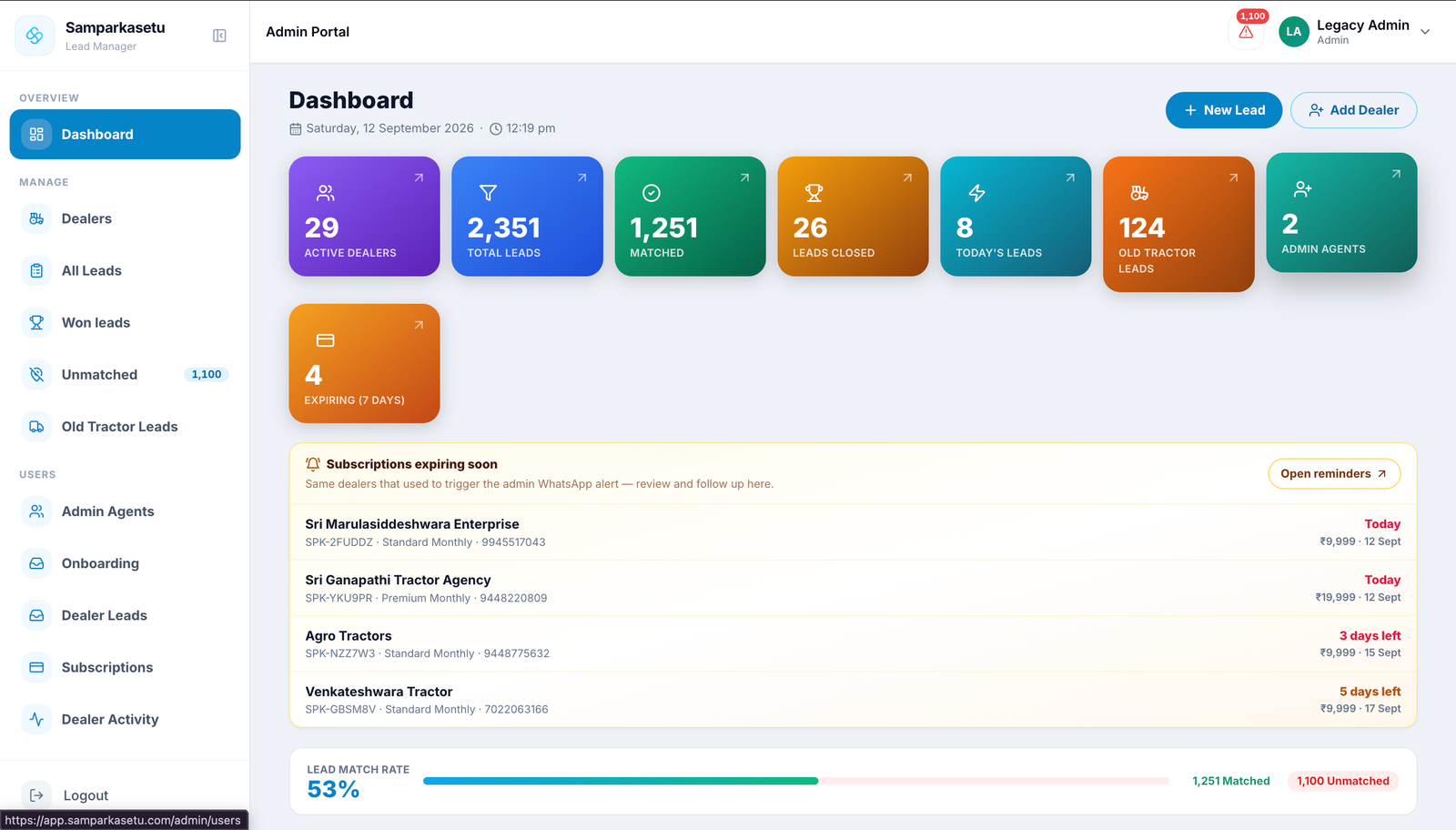
For agricultural equipment companies, generating leads is only one part of the sales process.
The bigger question is:
What do you actually know about those leads?
A company may receive thousands of enquiries for tractors, harvesters, implements, or other agricultural machinery. But if the sales team only has a name, phone number, and product enquiry, it becomes difficult to understand which opportunities are genuine, where demand is increasing, and which leads are most likely to convert.
This is where lead intelligence becomes important.
Lead intelligence helps agricultural equipment companies move beyond simply counting enquiries. It helps them understand the quality, intent, location, requirement, and journey of each potential customer.
In a competitive agricultural market, that information can make a major difference.
What Is Lead Intelligence?
Lead generation tells you:
“We received 1,000 enquiries.”
Lead intelligence asks:
“Who are these customers, what are they looking for, where are they located, how serious are they, and what happened after we received their enquiry?”
For agricultural equipment companies, useful lead intelligence can include:
- Customer location
- Product requirement
- Preferred brand or model
- Crop and farming activity
- Landholding or usage requirement
- Purchase timeline
- Budget or financing interest
- Dealer territory
- Lead source
- Follow-up activity
- Demo requirement
- Conversion status
When this information is connected, a company gets a much clearer picture of its market.
More Leads Do Not Always Mean More Sales
It is easy to assume that increasing the number of leads will automatically increase sales.
But imagine two scenarios.
Scenario 1
A dealer receives 500 enquiries.
Most contain limited information. Many are outside the dealer's territory, some are only looking for information, and several are duplicates.
Scenario 2
A dealer receives 200 enquiries.
Each lead includes the customer's location, equipment requirement, purchase timeline, and relevant product information.
The second group may have considerably more sales value.
This is why agricultural equipment companies should focus not only on lead volume, but also on lead quality and intent.
1. Understand Where Demand Is Coming From
Agricultural equipment demand is not the same everywhere.
A tractor model that performs well in one region may have different demand in another.
Crop patterns, farm sizes, soil conditions, terrain, irrigation, mechanization levels, and local purchasing behaviour can all influence equipment requirements.
With better lead intelligence, companies can identify:
- High-demand districts
- Fast-growing product categories
- Popular tractor segments
- Emerging markets
- Low-performing territories
- Dealer coverage gaps
Instead of relying only on historical sales data, companies can also use current enquiries to understand what customers are asking for right now.
2. Identify High-Intent Customers
Not every person who submits an enquiry is ready to purchase.
Some customers are researching.
Some are comparing brands.
Some may purchase after a few months.
Others may be ready to buy immediately.
Lead intelligence can help classify customers based on their level of interest.
For example:
High Intent
Planning to purchase soon and has a specific equipment requirement.
Medium Intent
Actively researching and comparing options.
Low Intent
Looking for general information with no immediate purchase plan.
This allows sales teams and dealers to prioritise their time.
Instead of treating every lead equally, they can focus first on the opportunities most likely to move forward.
3. Improve Dealer Lead Distribution
For agricultural equipment companies, the dealer network is one of the most important parts of the sales ecosystem.
But sending a lead to the wrong dealer can create problems.
A customer may be located outside the dealer's territory.
The dealer may not sell the requested product.
Or the dealer may already have limited capacity to handle additional enquiries.
Intelligent lead routing can consider factors such as:
Location + Product + Brand + Territory + Dealer + Customer Requirement
This allows companies to direct relevant opportunities to the appropriate dealer.
The result is a more connected relationship between the OEM, dealer, and farmer.
4. Know What Happens After the Lead Is Shared
This is one of the biggest gaps in traditional lead generation.
An OEM may generate a lead and pass it to a dealer.
But what happens next?
Was the farmer contacted?
Did the dealer follow up?
Was a demonstration arranged?
Did the customer request financing?
Was the opportunity lost?
If companies cannot see what happens after lead distribution, they are missing an important part of their sales intelligence.
A connected lead management system can provide visibility across the journey:
Lead Generated → Dealer Assigned → Contacted → Qualified → Demo → Follow-up → Negotiation → Sale/Lost
This creates accountability and gives companies a much better understanding of lead performance.
5. Measure Lead Quality, Not Just Lead Quantity
Traditional marketing reports often focus on numbers such as:
- Leads generated
- Campaign clicks
- Website visits
- Enquiries
These metrics are useful, but they don't tell the complete story.
Agricultural equipment companies should also ask:
How many leads were qualified?
How many reached the dealer?
How many were contacted?
How many requested a demo?
How many converted into sales?
This creates a much more meaningful metric:
Lead-to-Sale Performance
For example:
10,000 enquiries → 4,000 qualified leads → 2,500 contacted → 800 demos → 300 sales
Now the company can see where opportunities are being lost.
That is far more actionable than simply saying:
“We generated 10,000 leads.”
6. Use Data to Improve Marketing
Lead intelligence also helps marketing teams spend their budgets more effectively.
Suppose a company is running campaigns across multiple regions.
Campaign A generates 1,000 leads.
Campaign B generates 500 leads.
At first glance, Campaign A appears better.
But after analysing the actual sales journey:
- Campaign A produces 1,000 leads → 30 sales
- Campaign B produces 500 leads → 50 sales
Campaign B is generating fewer leads but significantly better business results.
Without lead intelligence, this difference can easily be missed.
With better data, companies can understand which campaigns generate customers—not just enquiries.
7. AI Can Make Lead Intelligence More Powerful
As the amount of customer data increases, AI can help companies identify patterns that are difficult to see manually.
AI can analyse lead information to identify:
- High-intent customers
- Likely conversion opportunities
- Product demand trends
- Territory-level demand
- Follow-up gaps
- Duplicate or low-quality enquiries
- Dealer performance patterns
Over time, this can help create a more intelligent sales process.
Instead of asking:
“How many leads did we get?”
the sales team can start asking:
“Which opportunities should we focus on today?”
That is a much more valuable question.
8. Lead Intelligence Helps Dealers Too
Better intelligence is not only useful for OEMs.
Dealers can use the same information to improve their own sales process.
A dealer can see:
- New opportunities
- Customer requirements
- Follow-up reminders
- Product interests
- Sales pipeline
- Conversion rates
- Lost opportunities
This reduces dependency on spreadsheets and disconnected communication.
A modern dealer CRM can turn customer enquiries into a structured sales pipeline.
9. Regional Data Matters in Indian Agriculture
India's agricultural market is highly diverse.
The customer in Punjab may have a very different equipment requirement from a farmer in Maharashtra, Karnataka, Telangana, or Tamil Nadu.
This makes regional lead intelligence especially valuable.
Companies can analyse demand by:
State → District → Taluka → Dealer Territory
This can help identify opportunities that may not be visible in national-level reports.
For an agricultural equipment company, knowing that a particular product is receiving increasing enquiries in a specific district can be valuable for dealer planning, inventory decisions, and marketing.
The Future of Agricultural Sales Is Data-Driven
Agricultural equipment companies have always had data.
The challenge is turning that data into useful intelligence.
The future is not simply about collecting more customer information.
It is about connecting the information across the entire sales ecosystem.
Farmer → Lead → Dealer → Follow-up → Demo → Sale → Customer Relationship
When these stages are connected, companies gain a clearer view of their market and their customers.
And when the data is combined with AI, CRM, analytics, and intelligent dealer matching, lead management can become a genuine business advantage.
Better Intelligence. Better Decisions. Better Sales.
Agricultural equipment companies don't necessarily need thousands of additional leads.
They need to understand the leads they already receive.
Which customers are serious?
Where is demand growing?
Which products are getting attention?
Which dealers are converting?
Where are leads being lost?
Which marketing channels are actually producing sales?
These are the questions that lead intelligence can answer.
The next generation of agricultural sales will be built around more than lead generation.
It will be built around understanding the customer, connecting the right dealer, and turning every opportunity into actionable intelligence.
For agricultural equipment companies looking to build a more connected lead and dealer ecosystem, technology can bring the entire journey together—from lead generation and qualification to dealer matching, CRM, analytics, and conversion.
The real value of a lead is not in the number.
It is in what you understand about it—and what you do next.
See how Samparkasetu connects the ecosystem
Explore our AI-powered CRM and lead-matching platform built for India's agri-dealers and OEMs.